

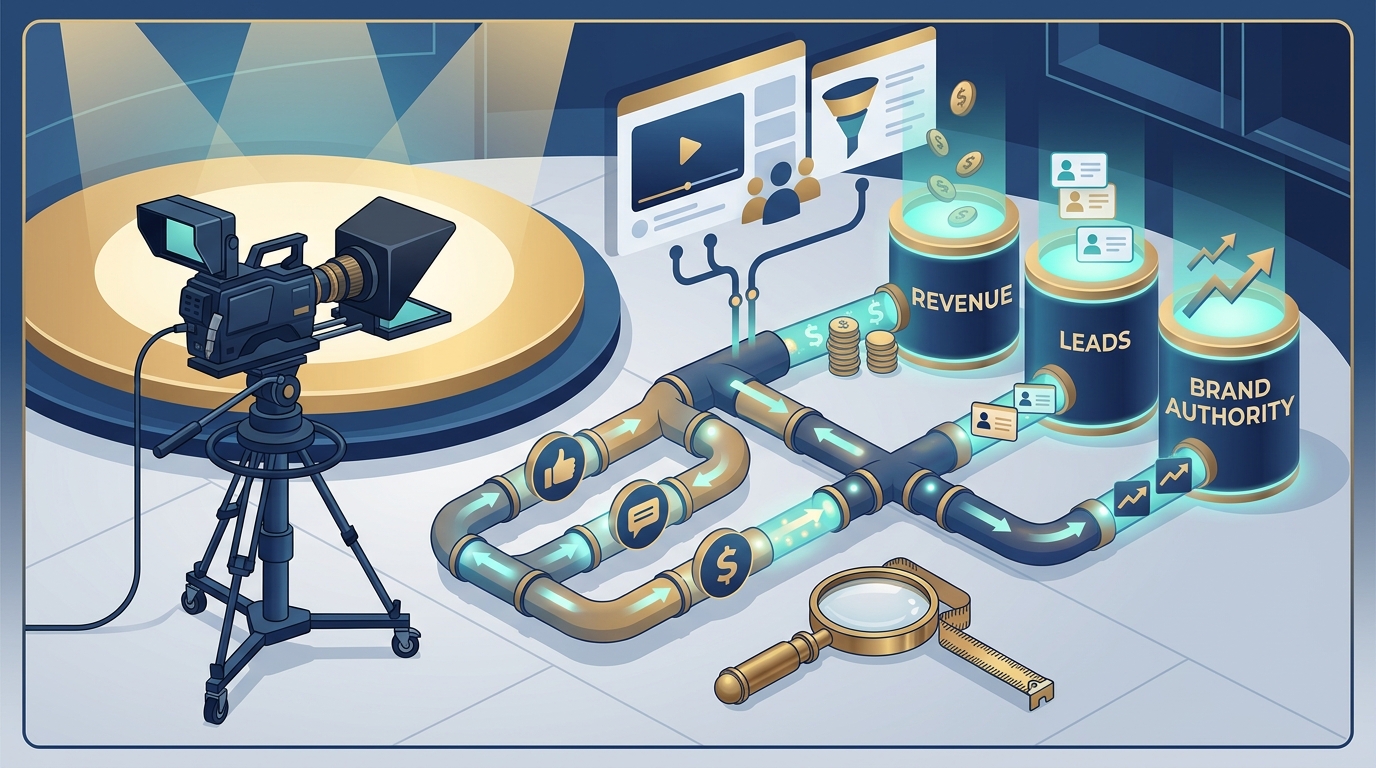
You invested time, energy, and money into creating video content for your business. But how do you know if it is actually working? Measuring the success of a video marketing campaign goes far beyond counting views. The right metrics connect your video efforts directly to revenue, lead generation, and brand authority. In this guide, we walk you through the key performance indicators (KPIs) every entrepreneur should track, explain how each metric maps to a specific business goal, and show you how to build a simple measurement framework that turns data into decisions. Whether you are just starting with video education or scaling an established strategy, these steps will keep your campaigns on track.
Why Measurement Matters for Video Marketing
According to Wyzowl's 2026 State of Video Marketing report, 91% of businesses now use video as a marketing tool, and 82% of marketers say it delivers a strong return on investment. Yet most marketers still rely on surface-level numbers like views and likes to judge performance.
A KPI is a measurable value tied directly to a specific business objective. A metric, by contrast, is any quantitative measurement. The difference matters: tracking the right KPIs prevents you from celebrating vanity numbers while missing real revenue signals. As Keri Murphy and the Inspired Living team teach, visibility only counts when it converts into authority and sales.
Step 1: Define Clear Campaign Goals First
Before you press record, decide what each video's job is. A brand awareness video has a completely different success metric than a sales conversion video. Trying to make one video do everything dilutes both the creative and the measurement.
Match One Goal to One Primary KPI
If your goal is brand awareness, measure reach and impressions. If your goal is lead generation, measure conversion rate. If your goal is engagement and trust-building, measure average watch time. This one-goal-one-KPI principle keeps your reporting focused and actionable.
Use the SMART Framework
Set objectives that are Specific, Measurable, Achievable, Relevant, and Time-bound. For example: "Increase website leads from video landing pages by 20% in Q3." This gives you a concrete benchmark against which to evaluate results.
Step 2: Track the Core Video Marketing KPIs
The five KPIs that connect video performance directly to business outcomes are view-through rate, engagement rate, click-through rate, conversion rate, and cost per lead. Here is how each one works:
| KPI | What It Measures | Why It Matters | Benchmark |
|---|---|---|---|
| View-Through Rate (VTR) | % of viewers who watch to completion or a milestone | Reveals if content holds attention | 18-30% prospecting; 30-45% remarketing |
| Click-Through Rate (CTR) | % of viewers who click a link or CTA | Shows intent to take action | 0.8%+ for mid-funnel B2B on LinkedIn |
| Conversion Rate | % of viewers who complete a desired action | Directly ties video to revenue | 5-10% for gated video assets |
| Average Watch Time | Mean duration viewers spend watching | Signals content quality and relevance | 50-60% of total video length |
| Cost Per Lead (CPL) | Ad spend divided by leads generated | Measures campaign efficiency | Varies by industry; track trend over time |
View-through rate (VTR) is the percentage of viewers who watched your video to completion or to a specific milestone like 25%, 50%, or 75%. It is one of the most revealing video marketing KPIs because platforms like YouTube and Facebook weigh watch time heavily in their algorithms.
Conversion rate is the percentage of video viewers who complete a desired action, whether that means signing up for a list, booking a call, or making a purchase. Including video on landing pages can boost conversion rates by up to 80%, making this metric essential for entrepreneurs who sell through their website.
Step 3: Map Metrics to Your Sales Funnel
Top of Funnel: Awareness
Track impressions, reach, and view count. A high impression count with a low play rate signals a thumbnail or headline problem, not a content problem. For short-form awareness videos on platforms like Reels and TikTok, videos under 30 seconds tend to perform best.
Middle of Funnel: Consideration
Track engagement rate, average watch time, and social sharing. This is where your essential video marketing strategy builds trust. Educational content, behind-the-scenes videos, and testimonial stories move prospects from curious to convinced.
Bottom of Funnel: Conversion
Track CTR, conversion rate, and cost per acquisition. Including video in email can increase click-through rates by up to 300%, driving more traffic to your sales pages. Positioning videos, like those created through the Inspired Living programs, are designed specifically to convert warm prospects into paying clients.
Step 4: Choose the Right Analytics Tools
You do not need expensive software to start measuring. Most platforms offer built-in analytics that cover the core KPIs.
YouTube Analytics provides detailed audience retention curves, traffic sources, and CTR data. Meta Business Suite tracks 3-second and ThruPlay views for Facebook and Instagram. Google Analytics 4 (GA4) connects video engagement on your website to downstream conversions and revenue. LinkedIn Campaign Manager reports video views, completion rates, and lead-gen form fills for B2B campaigns.
The key is centralizing your data. When metrics live in separate dashboards across platforms, you risk making decisions based on incomplete information. Even a simple spreadsheet that pulls weekly numbers from each channel gives you a unified performance picture.
Step 5: Optimize Based on What the Data Tells You
Measurement without action is just reporting. Here is how to turn insights into improvements:
Low VTR? Your hook is not strong enough. Test a new opening in the first three seconds. High views but low CTR? Your call-to-action needs to be clearer or appear earlier in the video. High CTR but low conversion? The issue likely sits on your landing page, not in the video itself.
Review your internal performance dashboards monthly. Refresh your understanding of industry benchmarks quarterly to account for platform algorithm changes and seasonal trends. A/B test video hooks, thumbnails, CTAs, and distribution channels regularly.
Entrepreneurs who work with on-camera training programs often see a compounding effect: better on-camera presence leads to higher watch times, which signals quality to algorithms, which increases organic reach.
Key Takeaways
- Always define one primary goal and one primary KPI per video before filming.
- The five core video KPIs are view-through rate, click-through rate, conversion rate, average watch time, and cost per lead.
- Map each metric to a specific stage of your sales funnel: awareness, consideration, or conversion.
- Platforms define "views" differently. Normalize your data before comparing performance across channels.
- Videos on landing pages can boost conversions by up to 80%, and video in email can lift CTR by up to 300%.
- Review dashboards monthly and refresh industry benchmarks quarterly.
- Measurement without optimization is wasted effort. Let the data guide your creative decisions.
Frequently Asked Questions
What is the most important video marketing KPI?
It depends on your goal. Awareness campaigns should focus on reach and views. Conversion campaigns should prioritize CTR and conversion rate. The best approach is to choose one primary KPI per video that aligns with its specific purpose.
Are video views a vanity metric?
In isolation, yes. But view count still matters as a directional indicator of reach when paired with unique viewers and impression data. The mistake is treating views as the only measure of success.
How often should I check my video metrics?
Weekly spot-checks help you catch problems early. A deeper monthly review is ideal for identifying trends and making strategic adjustments.
What is a good view-through rate for video ads?
For prospecting audiences, aim for 18-30%. For remarketing audiences who already know your brand, target 30-45%. These benchmarks apply primarily to skippable in-stream ads on platforms like YouTube.
How do I calculate video marketing ROI?
Use this formula: (Revenue attributed to video minus total video costs) divided by total video costs, multiplied by 100. Be sure to include production, distribution, and promotion costs. You can model projected ROAS using: Impressions x VTR x CTR x Conversion Rate x Average Deal Size divided by Ad Spend.
Does video length affect performance?
Yes. For top-of-funnel awareness on platforms like TikTok and Reels, videos under 30 seconds perform best. For mid-funnel education or webinars, longer formats work well when the content delivers consistent value. A strong benchmark for average watch time is 50-60% of total video length.
How can I improve my video conversion rate?
Start with a compelling hook in the first three seconds, include a clear CTA, and ensure your landing page experience matches the promise of the video. Working with experts on messaging and on-camera confidence also makes a measurable difference in how audiences respond.
What tools do I need to measure video performance?
Most entrepreneurs can start with free, built-in platform analytics from YouTube, Meta, and LinkedIn. Add Google Analytics 4 to track how video traffic converts on your website. As you scale, consider centralized reporting tools that pull data from multiple sources into one dashboard.
Ready to Create Videos That Actually Convert?
Knowing what to measure is only half the equation. You also need videos worth measuring. If you are ready to show up confidently on camera, craft messaging that resonates, and build a video strategy that drives real revenue, explore upcoming Inspired Living events and take the first step toward turning your brilliance into a brand your market cannot ignore.