

How to Measure Video Marketing Campaign Success: 7 Essential KPIs
You invested time, energy, and budget into a video marketing campaign. The content is live. Views are trickling in. But how do you know if it is actually working? Measuring video marketing success goes far beyond counting views. It requires tracking the right key performance indicators (KPIs) that connect your video content directly to business outcomes like leads, conversions, and revenue. In this guide, we walk you through the seven most important metrics every entrepreneur should track, plus how to use them to refine your strategy and grow your brand.
Why Measurement Matters for Video Marketing
According to Wyzowl's 2026 State of Video Marketing report, 91% of businesses now use video as a marketing tool, yet only 32% track bottom-line sales impact. That gap between investment and measurement is where real money gets wasted.
A KPI is a quantifiable value used to measure the effectiveness of marketing campaigns, directly linked to specific business goals. Without them, you are guessing. With them, every video you create becomes a data point that informs your next move. For entrepreneurs looking to leverage video to grow their business, measurement is the bridge between content creation and revenue.
Step 1: Define Clear Campaign Goals First
Before you look at a single metric, define what your video's job is. Is it building awareness? Generating leads? Converting prospects into paying clients? One video should have one primary objective and one primary KPI.
Match Goals to Funnel Stages
Top-of-funnel videos like brand stories are measured by reach and impressions. Mid-funnel content like testimonials and tutorials should track engagement and click-through rates. Bottom-of-funnel videos, such as the positioning videos created through the IT Factor Method™, focus on conversion rate and cost per lead.
Set Realistic Benchmarks
Use your own past data rather than generic industry averages. A benchmark is a reference point derived from previous campaign performance that helps you evaluate whether current results represent growth or decline. If this is your first campaign, start with a small test run and use those numbers as your baseline.
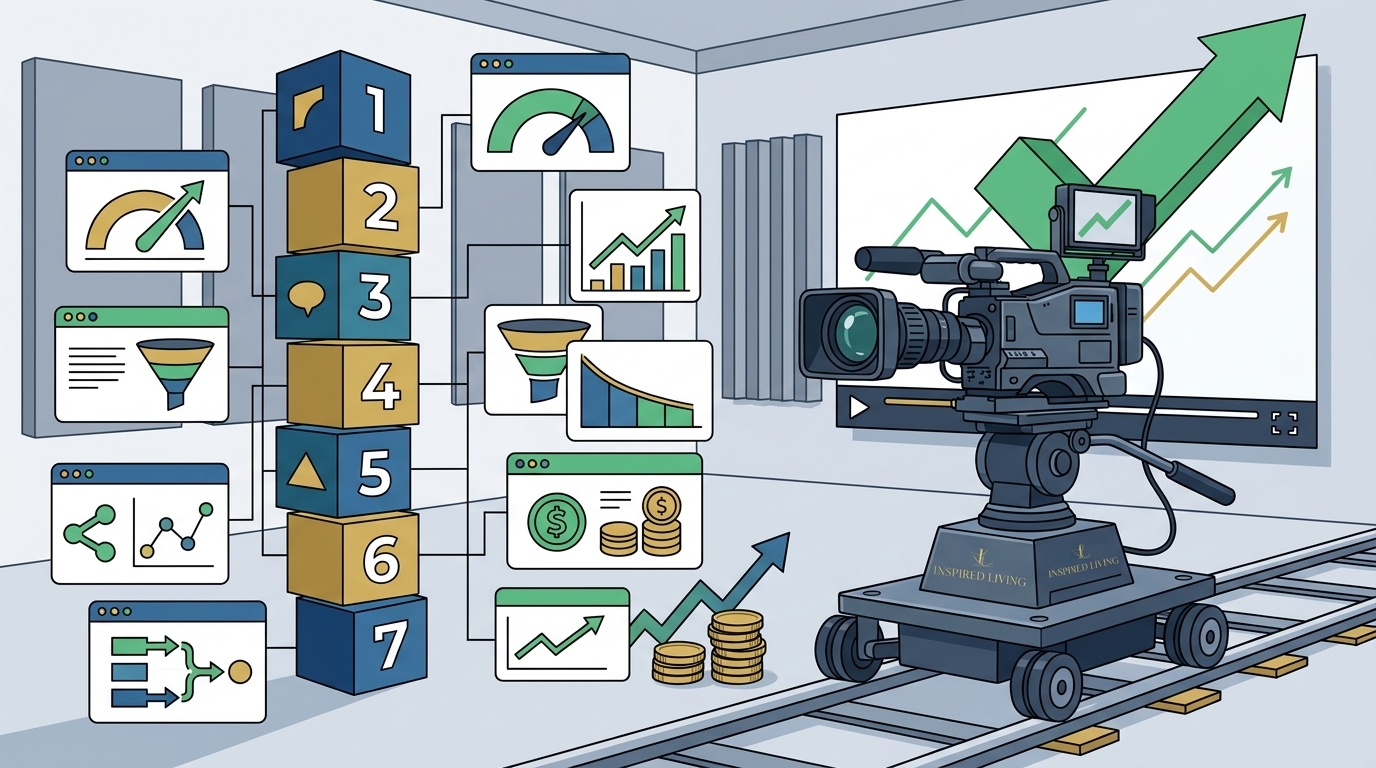
Step 2: Track These 7 Video Marketing KPIs
The table below maps each KPI to its funnel stage, what it tells you, and a healthy benchmark range.
| KPI | Funnel Stage | What It Measures | Benchmark Range |
|---|---|---|---|
| View Count & Reach | Awareness | How many unique people saw your video | Varies by platform |
| View-Through Rate (VTR) | Awareness / Engagement | % of viewers who watched to completion or a milestone | 50-60% of video length |
| Engagement Rate | Engagement | Likes, comments, shares relative to views | 3-6% organic social |
| Click-Through Rate (CTR) | Consideration | % of viewers who clicked your CTA | 2-5% for video ads |
| Conversion Rate | Conversion | % of viewers who completed a desired action | 1-3% landing page |
| Cost Per Lead (CPL) | Conversion | Ad spend divided by leads generated | Industry-dependent |
| Return on Investment (ROI) | Revenue | Revenue generated vs. total production and ad cost | Positive > breakeven |
Why View-Through Rate Matters Most for Entrepreneurs
View-through rate (VTR) is the percentage of viewers who watched your video to completion or to a specific milestone like 25%, 50%, or 75%. It reveals whether your content actually holds attention. If viewers drop off in the first few seconds, your hook needs work. If they leave before your call to action, your pacing may be off.
Shares Are the New Likes
Social platforms now weigh shares more heavily than likes in their algorithms. As Swydo's 2026 metrics guide notes, a share means someone found your content valuable enough to attach their personal reputation to it. Optimize for shareability by creating content that makes viewers look smart or helpful when they pass it along.
Step 3: Understand Platform-Specific Metrics
Not all views are created equal. A "view" is defined differently across every major platform, making cross-platform comparison tricky without normalization.
- YouTube: counts a view at approximately 30 seconds of watch time.
- Facebook: registers a view after just 3 seconds.
- TikTok: counts a view the moment the video starts to play.
- Instagram: counts every time the video appears on screen following their April 2025 update.
When comparing performance across platforms, use 30-second views as a standardized comparison point. This prevents misleading apples-to-oranges reporting. If you are building a multi-platform video marketing strategy, understanding these nuances is critical.
Step 4: Choose the Right Analytics Tools
Each social platform offers native analytics dashboards. YouTube Studio, Meta Business Suite, TikTok Analytics, and LinkedIn Analytics all provide baseline data. For centralized tracking across channels, tools like Google Analytics 4 (GA4), Wistia, and dedicated video reporting platforms can aggregate data into a single view.
GA4 is especially valuable for tracking what happens after the click. It ties video engagement to on-site behavior like form fills, purchases, and page depth. For entrepreneurs who want to understand how video drives website conversions, GA4 is essential.
Step 5: Optimize Based on Your Data
Data without action is just noise. Once you review your KPIs, make specific adjustments.
Low View-Through Rate?
Rework your opening hook. The first three seconds determine whether viewers stay or scroll. Consider opening with a bold question or surprising statistic.
High Impressions but Low Play Rate?
This signals a thumbnail or headline problem. Experiment with more eye-catching visuals and clearer value propositions. A/B test different thumbnails to find what earns the click.
Clicks but No Conversions?
Your landing page may not align with the video's promise. Ensure messaging continuity between your video CTA and the destination page. Videos on landing pages can boost conversion rates by up to 80%, but only when the experience feels seamless. The success stories from Inspired Living clients consistently show that aligned messaging and confident on-camera presence drive real conversions.
Key Takeaways
- Define one primary goal and one primary KPI per video before you hit record.
- Track view-through rate, engagement, CTR, conversion rate, CPL, and ROI as your core metric stack.
- Normalize view counts across platforms using 30-second views as the standard.
- Shares now carry more algorithmic weight than likes on Instagram and TikTok.
- Use GA4 to connect video engagement to on-site conversions and revenue.
- A/B test thumbnails, hooks, and CTAs to systematically improve underperforming videos.
- Review KPIs weekly or monthly to catch trends early and reallocate budget wisely.
Frequently Asked Questions
What is the most important KPI for video marketing?
The most important KPI depends on your campaign goal. Awareness campaigns should prioritize reach and views. Conversion-focused campaigns should track CTR and conversion rate. Always align your primary KPI with your primary business objective.
How often should I review my video marketing metrics?
Weekly or monthly reviews work best. Regular tracking helps you identify trends early and make timely adjustments before budget is wasted on underperforming content.
Why is view count considered a vanity metric?
View count in isolation does not tell you whether viewers took action. However, when paired with unique viewers and engagement data, it serves as a useful directional indicator of reach. The key is never relying on view count alone.
How do I compare video performance across different platforms?
Use 30-second views as your standardized comparison point. Each platform defines a "view" differently, so raw view counts are not comparable without normalization.
What is a good view-through rate for video?
A strong benchmark is 50 to 60% of total video length, though this varies by platform and video format. Short-form content on TikTok often sees higher completion rates than long-form YouTube videos.
How can video marketing help my business get found on Google?
Websites with video content are significantly more likely to rank on the first page of Google search results, thanks to improved dwell time and engagement. Adding video to your marketing and media strategy supports both SEO and audience trust.
Do I need expensive tools to track video KPIs?
No. Every major platform provides free native analytics. Google Analytics 4 is also free and tracks on-site behavior after video clicks. Paid tools become valuable when you manage multiple platforms and need centralized, automated reporting.
How does Inspired Living help entrepreneurs with video marketing?
Inspired Living uses the signature IT Factor Method™ to help entrepreneurs master on-camera presence, clarify their message, and create video content that converts viewers into clients across multiple platforms.
Ready to Turn Your Videos Into Revenue?
Tracking the right KPIs is how you stop guessing and start growing. If you are ready to build a video marketing strategy that delivers measurable results, book a complimentary visibility strategy call with the Inspired Living team and get clarity on your next steps.